





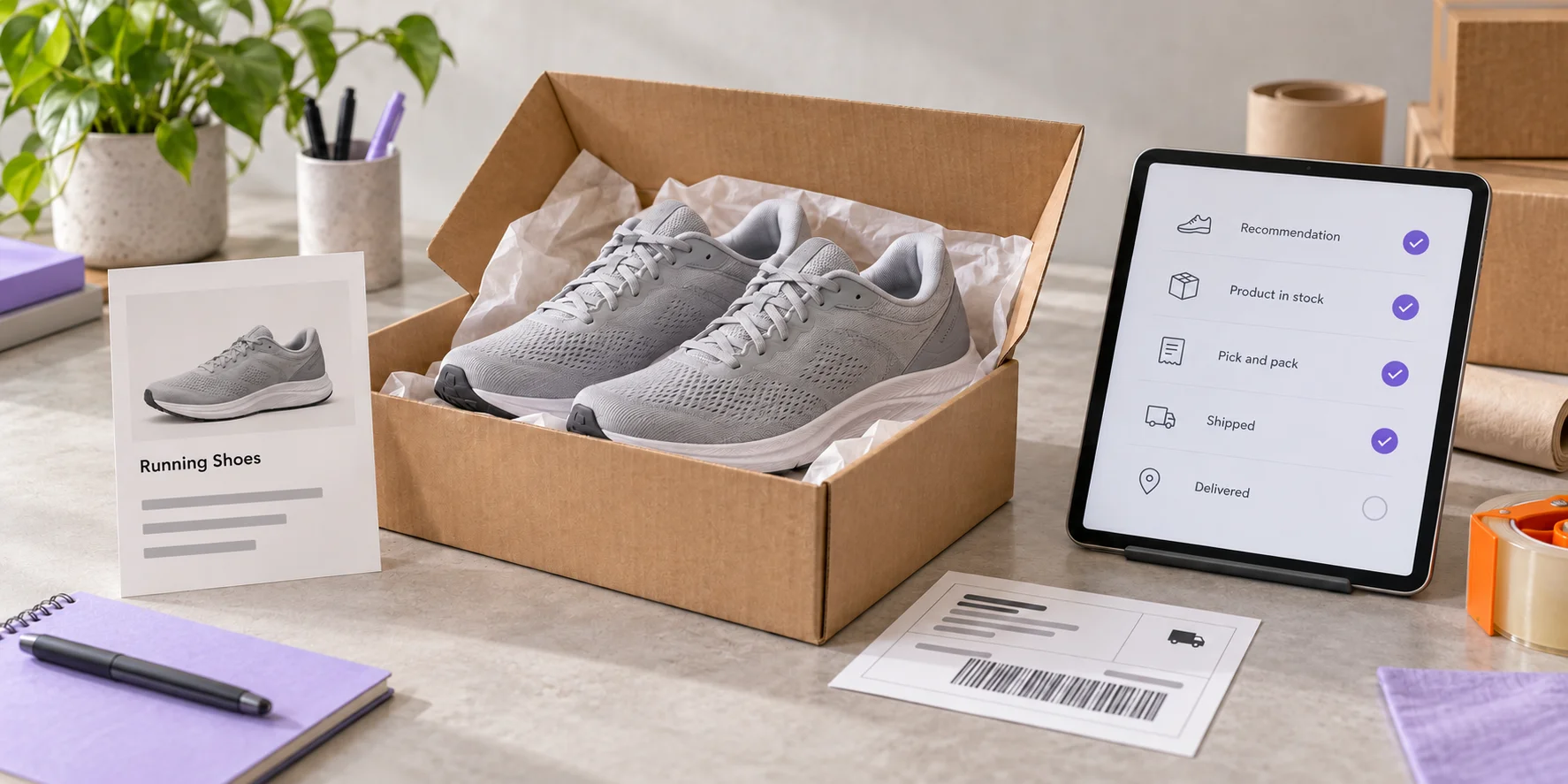

AI shopping can help a buyer discover and compare products; agentic commerce can also connect an assistant to parts of a purchase. Being mentioned in an answer and being able to complete checkout inside that platform are different capabilities. A merchant needs reliable product information for the first, and an eligible, supported commerce connection for the second.
For a Malaysian store, the practical starting point is a product and fulfilment readiness check. Do not build an integration on the assumption that every advertised feature is available to every buyer or account.
Separate Discovery From the Transaction
Imagine a kitchen-appliance retailer whose compact oven appears in an answer about small apartments. A buyer still needs the correct model, usable capacity, current price, delivery coverage and installation conditions. An attractive recommendation does not establish any of those facts.
| Stage | What the merchant needs |
|---|---|
| Product discovery | Accurate public product pages and supported product-data sources |
| Comparison | Clear specifications, meaningful differences and verifiable conditions |
| Purchase | An eligible checkout route, valid offer and correct order information |
| Fulfilment and aftercare | Stock, shipping, support, cancellations and returns that actually work |
Our AI product-research guide covers the buyer's source-checking task. This article covers the merchant's operational preparation.
Understand What a Commerce Protocol Does
The Universal Commerce Protocol (UCP), co-developed by Google and industry partners, describes a way for commerce systems and AI experiences to communicate. Depending on the supported implementation, capabilities can involve catalogues, carts, identity and checkout. A protocol is an integration standard, not an SEO ranking instruction.
The normal store still needs to keep its offer accurate and fulfil the order. Adopting a protocol does not automatically put every product into recommendations, approve a Merchant Center account or replace the merchant's customer-service responsibilities.
Check the Specific Route and Buyer Market
Availability must be read at the level of the actual provider and channel. As checked on October 30, 2026, Google's direct Merchant Center UCP onboarding help describes a gradual US rollout and says Australia and Canada are planned for the following year. It requires technical implementation, an interest process and selection before onboarding.
Shopify's current help for its Google channel describes eligible selling to buyers in the US, Canada and Australia, while allowing the merchant to be based elsewhere. That is a channel-specific statement. It should not be combined with Google's direct-onboarding page into one universal availability claim.
For a Malaysia-based shop, write down the provider, account eligibility, supported buyer country, products and order conditions. The merchant's location alone does not establish that Malaysian buyers can use direct checkout. If the route is not available, continue improving normal product discovery and the website buying process.
Make the Product and Offer Consistent
Start with one real product and one purchasable variant. Check the page, catalogue connection and inventory source together. The selected model, image, price, currency, stock and purchase URL should describe the same offer.
For the oven, distinguish external dimensions from usable capacity and confirm which installation service, if any, is included. State shipping destinations, charges, handling conditions and returns clearly. Do not infer installation coverage from a general delivery statement.
Use our Merchant Center guide for product-data preparation and our variant guide where model or option selection changes the offer.
Prepare an Operating Record Before Integration
The following is an illustrative readiness record for the oven—not evidence of a live merchant deployment. Replace its open questions with actual store facts.
| Area | Decision or evidence required | Owner |
|---|---|---|
| Product identity | Exact model, variant and applicable identifiers match across systems | Catalogue team |
| Price and stock | Identify the authoritative source and how changes reach the channel | Store operations |
| Buyer eligibility | Confirm the account route and supported destination before building | Integration owner |
| Delivery and installation | Separate shipping terms from any installation offer | Operations |
| Order handoff | Define where accepted orders, errors and cancellations appear | Order team |
| Returns and support | Confirm the policy and team that handles a problem | Customer service |
| Measurement | Identify supported channel/order records and their limits | Analytics owner |
For this oven, a provisional decision could be: continue website sales and prepare accurate discovery data, but keep direct checkout on hold until the integration owner confirms support for the intended Malaysian buyers. That gives the team a clear next task before it commits to development.
Choose a stopping condition before spending on development. For example, if the intended buyer market is unsupported or stock cannot stay accurate, resolve that constraint first. A technically connected but unreliable offer is not a successful commerce system.
Test and Measure the Supported Path
Use the provider's approved onboarding and test environment when available. Check product selection, stock changes, totals, delivery, order acceptance and cancellation/return handling. Keep test orders distinguishable from real orders and verify the resulting records.
Do not assume an external platform's embedded checkout runs the same analytics as the store website. Shopify's Google-channel guidance, for example, says GA4 and custom client-side pixels do not fire inside that channel's checkout. Use the reporting and order information actually supported by the route.
Keep product exposure, website visits, checkout starts, accepted orders and fulfilled orders separate. Our GA4 events guide explains why an interaction is not automatically a completed business outcome.
Choose a Practical Next Step
If accurate product discovery is the current gap, fix one product page and data record first. If a supported commerce route fits the buyers you actually serve, complete its eligibility and operating checks before implementing it. Revisit the decision when the provider's availability or the store's capabilities change.
Frequently Asked Questions
Is an AI Recommendation the Same as AI Checkout?
No. A recommendation can link to a normal store. Completing a transaction within a platform requires a supported, eligible commerce route.
Can a Malaysian Store Use AI Checkout?
It depends on the provider, merchant account, buyer country and products. A Malaysia-based merchant's eligibility for certain foreign buyers does not establish direct-checkout availability for Malaysian buyers.
Will UCP Make My Products Rank in AI Answers?
It is an interoperability protocol, not a recommendation guarantee. Reliable product information and the platform's actual discovery rules still matter.
Will My Normal GA4 Setup Record Every AI-Platform Order?
Do not assume so. Embedded or external checkout paths can have different measurement support. Check channel documentation and actual order records.