





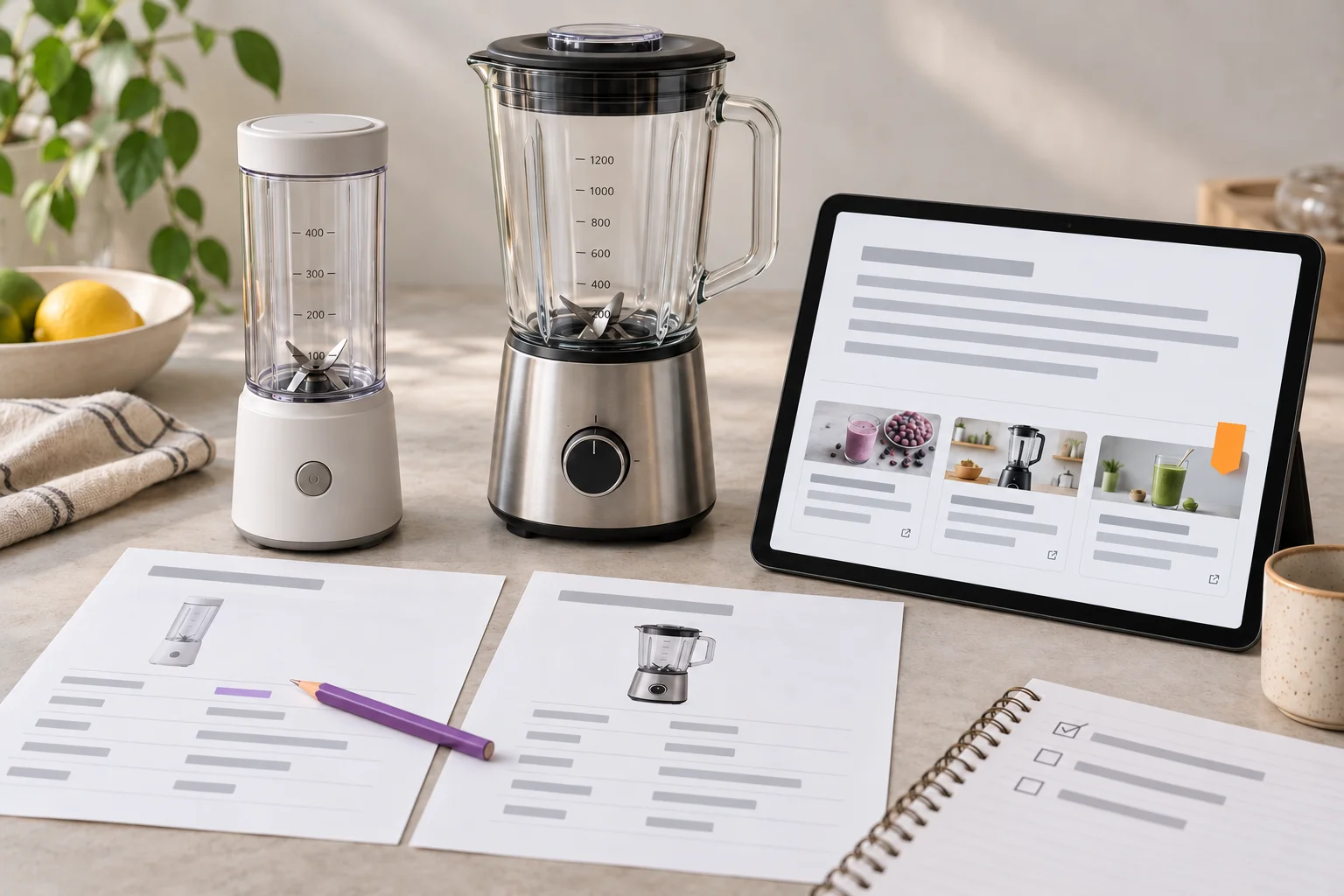

Use Google, ChatGPT Search or Perplexity to build a product shortlist, then verify the important claims on original manufacturer and merchant pages. A useful shortlist identifies the exact models and gives you evidence to check their price, suitability and warranty.
This is a source-checking workflow, not a head-to-head accuracy test. It uses an illustrative brief for a compact blender in a Malaysian home and does not name an untested “best” model.
Write the Buying Brief First
A practice brief might be: a blender for small daily batches, a maximum total budget of RM500, a compact footprint, delivery to Kuala Lumpur and a warranty that can be used locally. The budget is a chosen exercise constraint, not a claim about current product prices.
List what would rule a product out: dimensions, unsuitable capacity, unavailable replacement parts or a total cost above the budget. Check any use requirement with the manufacturer's instructions; marketing phrases such as “powerful” do not establish that a blender can safely perform every task.
Understand What Each Interface Provides
| Interface | How to use it for the task | What remains to verify |
|---|---|---|
| Ordinary Google Search | Find manufacturer pages, merchants, reviews and original documents | The exact model, source credibility and current offer |
| Google AI Mode | Ask a more complex question and follow linked sources or follow-ups | Whether the synthesis represents those sources accurately |
| ChatGPT with web search | State requirements, request sources and investigate a shortlist | That search was used and that cited pages support the claims |
| Perplexity Search | Review a source-linked answer and ask focused follow-ups | The original evidence behind the recommendation |
Ordinary Google results and AI Mode are different experiences. Likewise, an answer generated without web retrieval is not the same as an answer using current search sources. Account settings, limits, region and product changes can affect available controls; do not assume every shopping or checkout feature exists in Malaysia.
Perplexity's current help describes Search rather than a separate Pro Search toggle. Use the controls actually offered to your account. Our AI search guide explains retrieval and generated answers.
Use the Same Requirements Across Services
For a fair practical comparison, keep the buying brief unchanged. For example:
Help me shortlist compact blenders for small daily batches in Malaysia. My total budget is RM500 including delivery to Kuala Lumpur. For each candidate, identify the exact model and give sources for capacity, dimensions, local warranty and current purchase conditions. Mark anything you cannot verify.
For conversational tools, start a new conversation. For ordinary Google Search, keep the query and relevant location/language settings consistent. Record the date, service, displayed mode and relevant account conditions. If a service is unavailable or requires access you do not have, record that limitation rather than replacing its answer with a web-search summary and calling it a test.
Retrieval, personalisation and timing can produce different shortlists. Compare the evidence for your requirements rather than how confidently a service recommends a product.
Open the Sources Behind Important Claims
For each candidate, inspect the exact model and variant. A source about a larger model from the same brand does not verify the compact model's capacity. A retailer's description may establish its own advertised offer; it does not automatically establish independently tested performance.
Use manufacturer information for specifications and permitted use, the seller's current page for the offer, and relevant independent testing for claims about performance. Check whether a review explains what was actually tested. An AI answer linking a source is an invitation to inspect it, not proof that every nearby statement is supported. See our citations and mentions guide.
Keep a Small Research Record
Use a record like this for the shortlist. The rows are a verification plan, not findings from a product test.
| Claim | Evidence to check | Decision if unresolved |
|---|---|---|
| Fits the kitchen space | Dimensions for the exact model; your measured space | Leave fit unconfirmed |
| Suitable for the intended batch or ingredient | Manufacturer instructions and relevant documented testing | Do not infer suitability from motor wattage alone |
| Within the total budget | Current selected item, delivery destination and checkout charges | Compare only after total cost is established |
| Usable local warranty | Seller, distributor and written warranty conditions | Ask the seller to clarify coverage |
| Available now | The actual merchant's selected offer and delivery conditions | Do not treat an old result as confirmed stock |
For each shortlisted model, add the source URL, date checked and a status: confirmed, contradicted or unresolved. Record the remaining question and keep any disagreement between sources visible.
Check the Final Offer Before Buying
Return to the merchant and confirm the model, variant, seller, final total, stock, delivery and return/warranty conditions. Google Shopping itself notes that the merchant determines the final price and that location can affect it. Generated recommendations and displayed prices may not capture every current condition.
A product recommendation, an advertisement and the ability to check out inside a platform are also different things. Our AI shopping guide explains the transaction side.
For a website owner, the practical lesson is to publish reliable specifications and buying conditions that can be checked against the actual offer. Our product-page guide shows how to organise those details.
Frequently Asked Questions
Which Platform Is Best for Product Research?
Use the one that helps you find and verify the right evidence for your task. This guide does not establish an accuracy winner; using a second suitable source can reveal missing information.
Do AI Answers Show the Current Final Price?
Do not assume so. Check the exact offer and delivery destination with the merchant before buying.
Does a Citation Mean the Product Was Independently Tested?
No. The cited page may be a retailer listing, manufacturer description or commentary. Read its method and what it actually supports.
Why Do the Services Recommend Different Products?
Sources, interpretation, settings and timing can differ. Compare the underlying evidence and your requirements instead of treating repeated recommendations as proof of quality.