





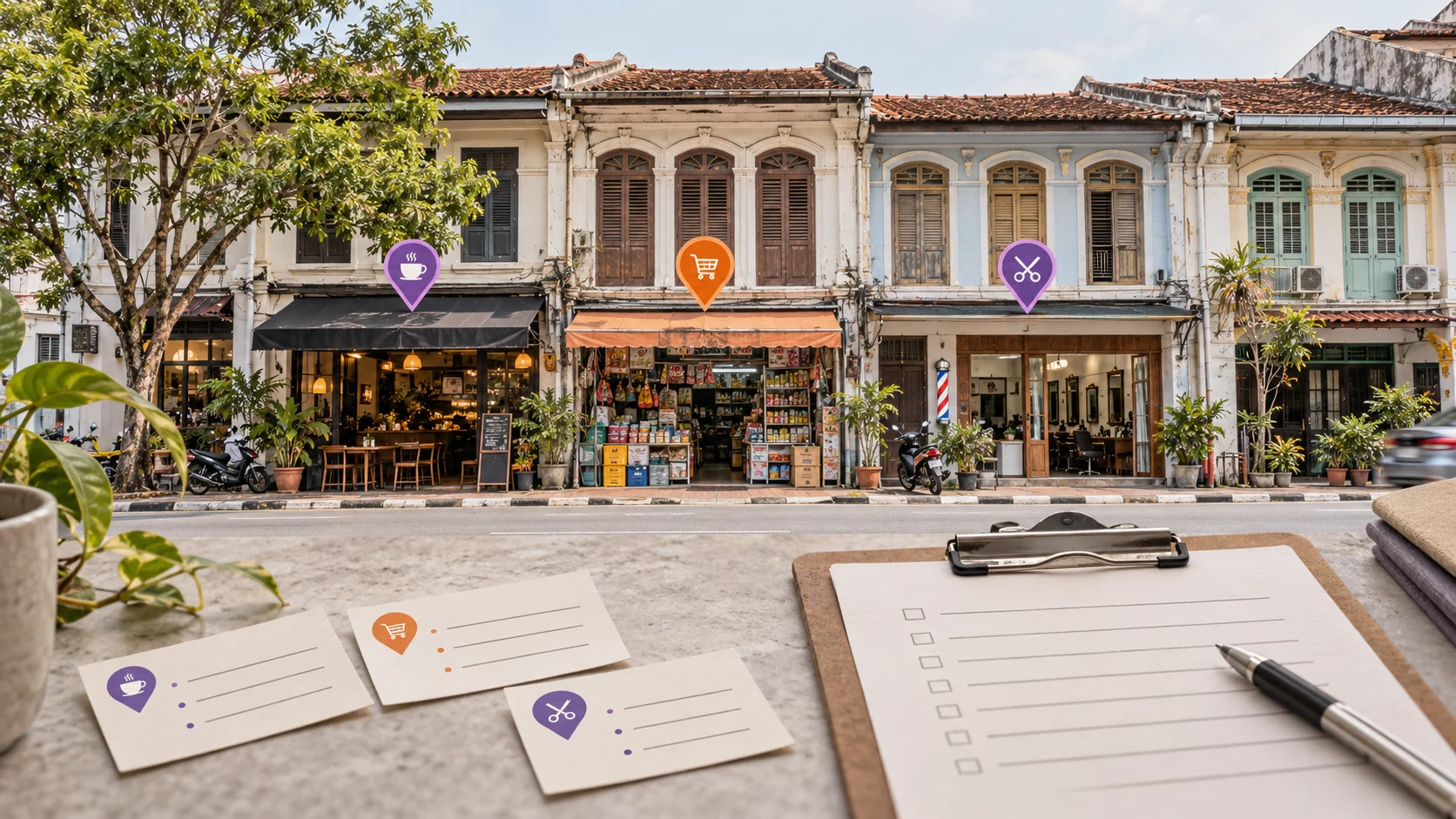

Ask an AI search tool for a repair company in Petaling Jaya. Then ask the same question in Malay and Chinese. Will you receive the same shortlist?
In our small check, we did not. Three separate Perplexity Search answers returned three different sets of names. The English answer listed three businesses, the Malay answer one, and the Chinese answer three. None of those displayed names appeared in more than one answer.
That is an observation from three responses, not evidence that language alone caused the difference. The useful lesson is narrower: a single AI answer is a poor way to measure a local business's visibility.
What We Checked
On 30 October 2026, between approximately 11:21 and 11:24 p.m. Malaysian time, we used the unsigned-in Perplexity Search interface. We opened a separate conversation for each language and retained the first completed answer.
Each prompt described the same task: someone in Petaling Jaya needed air-conditioner repair. It requested up to three businesses, a source for each, and details to confirm before booking. It explicitly asked the tool not to invent availability, prices or telephone numbers.
The English prompt was:
I am in Petaling Jaya and need an air-conditioner repair service. Suggest up to three businesses, give a source for each, and say what I should confirm before booking. Do not invent availability, prices or phone numbers.
The Malay prompt was:
Saya berada di Petaling Jaya dan memerlukan khidmat pembaikan penyaman udara. Cadangkan sehingga tiga perniagaan, berikan sumber bagi setiap satu dan nyatakan perkara yang perlu saya sahkan sebelum menempah. Jangan reka ketersediaan, harga atau nombor telefon.
The Chinese prompt was:
我在八打灵再也,需要冷气维修服务。请推荐最多三家商家,为每家提供来源,并说明预约前应该确认什么。不要编造是否有空、价格或电话号码。
We recorded the question, answer, visible sources, conversation URL and capture time. The interface showed Search mode; we did not verify the underlying model or the browser's actual geographic location. The place name was part of the prompt.
What the Three Answers Returned
| Prompt language | Business names shown | Source observation |
|---|---|---|
| English | ARZ Air-Cond & Electrical Services; NR PROTECH AIRCOND SERVICE & ELECTRICAL; AC Repair MY | Three distinct inline destination URLs were captured: a directory, a service marketplace listing and a business website. |
| Malay | KL Renovator | The answer said it could verify only one option. Source labels were visible, but our capture did not resolve their destination URLs. |
| Chinese | Aircon Hero Sdn Bhd; Setia Air-Cond & Electrical Sdn Bhd; MK Aircon Service | All three business rows cited the same third-party roundup. A second website appeared in broader booking advice. |
These are names returned by the interface, not our recommendations or independently confirmed business identities. We did not contact the companies, test their services or verify appointment availability.
Two details matter more than the apparent difference in shortlist length.
Repeated Citations Were Not Independent Confirmation
Our saved Chinese-response capture contained twelve citation-link instances, but they resolved to only two distinct URLs. The three business rows all pointed to one roundup.
Opening that roundup confirmed it contained the named businesses. It did not independently establish the quality, availability or current terms of their services. Several citations to the same page should not be counted as several independent recommendations.
The Malay result illustrates a different collection limit. We saw source labels, yet our saved link extraction contained no destination URLs. Calling that an “answer without sources” would confuse an incomplete capture with the interface's actual contents.
A Directory's Ranking Was Not Our Ranking
The English answer described one business as ranked first in a directory. We could not retrieve that directory page during the subsequent source check, so we left the ranking unverified.
We also opened the business-domain destination associated with another candidate. The answer called it “AC Repair MY”; the linked homepage used the name “Chill Pro Air-Cond & Refrigeration”. The displayed names differ, so verify which business the domain represents before booking. Its homepage presented its own service and coverage claims: a first-party business source, not an independent service assessment.
A reader still needs to check the exact company, address covered, repair type, diagnostic charge, appointment and warranty directly. A confident summary does not perform those checks on the reader's behalf.
Where the Check Stopped
Our original plan included three local tasks in three languages: air-conditioner repair, tuition and kitchen-appliance shopping. Only the three repair prompts produced independent completed responses suitable for this comparison.
A sign-up gate then prevented a clean continuation. Two tuition attempts remained in the existing repair conversation rather than fresh conversations; we excluded both. The remaining four planned prompts were not attempted after the gate. Those records were retained, rather than replaced with more favourable results.
We also tried the public ChatGPT entry, which presented an access challenge before a prompt could be submitted. No ChatGPT answer was collected. This article therefore makes no comparison between platforms.
There was one usable response per language, no repeated runs, no controlled model selection and no verified geolocation. The prompts were equivalent in purpose, not mechanically identical. We cannot separate language effects from ordinary response variation or other hidden conditions.
What a Local Business Can Learn
The observed variation is a reason to keep a visibility log, not to chase whichever business appeared in one answer.
- Fix the task before testing. Record the service and area a customer needs, such as repair in PJ. Do not mix repair with cleaning, installation or general advice.
- Record the full conditions. Save the exact prompt, language, interface, mode, account state, date, response and source destinations. Mark unknown conditions as unknown.
- Count the right thing. A named business, a linked source, a product suggestion and a source-list badge are different observations. Deduplicate destination URLs.
- Check what each source supports. A directory may establish that a name is listed. A business page may describe its services. Neither automatically proves that it can accept today's booking.
- Repeat before drawing a trend. Use a planned schedule and retain omissions, errors and access failures. One appearance or absence cannot establish a reliable share of recommendations.
For the website itself, start with accurate service coverage, clear contact details and pages that answer the customer's actual task. Our local SEO guide explains those foundations. The trilingual keyword workflow helps distinguish equivalent language pages from different search needs.
For a customer comparing purchases rather than booking a service, use the verification steps in our AI product-research guide. The same rule applies: follow the source before relying on the summary.
Frequently Asked Questions
Did Language Cause the Different Recommendations?
This check cannot establish that. We observed different names across three language prompts, but one response per language cannot isolate language from response variation, model behaviour or other uncontrolled conditions.
Why Did the Malay Answer Show Only One Business?
The response said it could verify only one option. We recorded that explanation; we did not independently establish why the system selected fewer names.
Does Being Listed Mean a Business Ranks Well in AI Search?
It means the business appeared in that particular answer. A broader visibility claim requires repeated observations across relevant tasks and clearly recorded conditions.
Can Several Citations Prove a Recommendation Is Reliable?
No. Citations may repeat the same source, and the source may not support every claim. Check distinct destinations, the evidence on each page and the details that still need direct confirmation.