





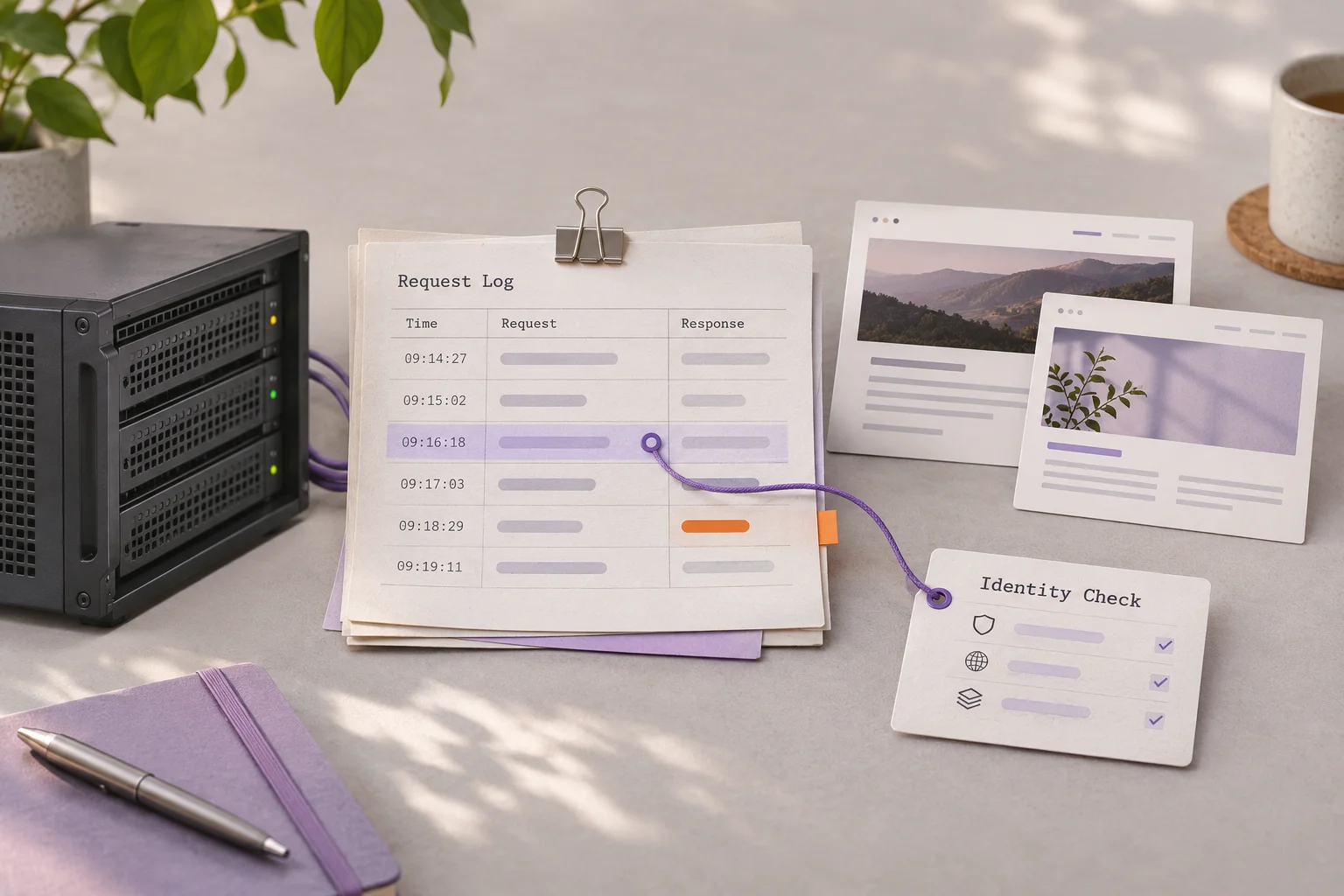

AI crawler log analysis checks whether a claimed crawler requested your pages and what response your infrastructure returned. Verify the requester's identity before counting it as vendor activity, and keep access separate from AI citations or referral traffic.
A log can show a request to a guide. It cannot establish that the guide appeared in an answer or influenced a model.
Choose the Log Layer and Window
Use authorized access logs from the host, server or CDN. Keep raw addresses and sensitive request parameters private; publish only the minimum aggregate evidence needed. Record the date window, timezone, retention and whether the dataset is sampled. Origin logs may miss cached requests, while edge-blocked requests may appear only at the CDN.
For an education website investigating access to a course guide, keep requests for that guide separate from images, scripts and unrelated URLs. Record the exact path and response rather than treating all log lines as content visits.
| Field | Purpose |
|---|---|
| Timestamp and timezone | Place the request in the correct investigation window |
| Trusted client address | Support vendor verification privately |
| Reported user agent | Identify a candidate crawler |
| Method, host and path | Identify what was requested |
| Status and redirect destination | Inspect the response path |
| Log layer and verification result | Preserve the limits of the conclusion |
Behind a proxy, the recorded address may belong to the proxy. Confirm trusted client-IP handling with the host or CDN. An arbitrary client-supplied forwarding header is not dependable identity evidence.
Classify the Agent Before Counting
A user-agent string is a claim that can be copied. Label matches as candidates until you apply the provider's current verification method.
Keep purposes separate. OpenAI documents OAI-SearchBot for search, GPTBot for potential training use and ChatGPT-User for user-triggered access. They are not interchangeable evidence of one “AI visibility” result.
Google-Extended is a robots.txt control token without a separate HTTP user agent. Looking for it as a distinct request agent will not produce a reliable count.
The AI crawlers guide explains the access controls. This analysis concerns what the available logs actually record.
Verify Using the Vendor's Method
| Provider | Verification route |
|---|---|
| OpenAI | Select the claimed agent in current crawler documentation and compare the trusted source IP with its published applicable prefixes |
| Use documented reverse-and-forward DNS verification or the appropriate crawler-category IP feed | |
| Bing | Use documented reverse-and-forward DNS verification, the verifier or the current Bingbot IP feed |
For Google's DNS route, reverse-resolve the client IP, validate the documented domain for that crawler category, then forward-resolve the hostname and confirm the original address. A hostname containing the word “google” is insufficient.
For Bing's documented DNS route, check the proper search.msn.com domain ending and the matching forward resolution. Do not transfer that rule to another provider or treat every Microsoft cloud address as Bingbot.
Keep range data current and record the verification time. Use the actual provider's published feed rather than hard-coded example IPs. If evidence is unavailable or inconclusive, retain an unverified label instead of asserting a genuine bot or an attacker.
Read the Response and Next Check
For the course guide, inspect the recorded request and any redirect chain. A 200 response indicates HTTP success. Check the method: a successful HEAD request does not establish that page content was transferred. For a content response, check that it contains the intended guide rather than a challenge or empty shell.
A 403, 429 or server error is a clue to investigate access rules, rate limits or availability. The status alone does not identify the responsible layer. Compare edge and origin evidence where available.
If access was blocked unexpectedly, identify the rule and owner before changing it. A simulated request with a copied user agent is not a test by a verified real crawler. Check the intended robots.txt rules separately from firewall behavior.
Report Access Without Inventing Visibility
Use a precise record: claimed agent, verification method, requested page, response, date window and dataset limitations. For the guide, “verified search crawler requested this URL and received this response” is a defensible access observation.
Do not rename request counts as AI impressions, citations or sessions. No requests in one limited log window also cannot prove that a provider never accessed the site.
Keep answer citations, search indexing and recorded AI referral sessions in separate measurement records. Each needs its own evidence.
Frequently Asked Questions
Is a GPTBot or Bingbot User Agent Enough to Verify a Visit?
No. The string can be copied. Use the relevant provider's current verification method and preserve an unverified label when the result is inconclusive.
Why Can I Not Find Google-Extended in Access Logs?
It has no distinct HTTP user agent. It is a robots control token, not a separately identifiable requester in that field.
Does Zero Recorded Activity Mean AI Crawlers Never Visited?
No. Retention, sampling, caching, log layers and the selected window can leave gaps. State what the dataset covers.
Does a Successful Request Mean My Page Was Cited?
No. A response records access. A citation, ranking or referral session requires a separate observation.